
Home / What we do / Why TruLife
More than a broker, distributor or consultant.
An outsourced U.S. commercial function — the operating team that stands in for the American headquarters you don't have. Here is how that differs from the three things it is most often mistaken for.
The problem
Most brands buy the wrong shape of help, not the wrong supplier.
An international brand decides to enter the United States and starts assembling help. A regulatory consultant for the labeling. A customs broker for entry. A third-party logistics provider for storage. A sales agency for buyer access. A marketing firm for the launch.
Five contracts, five invoices, five partial views of the same brand. The consultant's responsibility ends at the report. The customs broker's ends at the port. The 3PL never speaks to the buyer. When the first purchase order is missed, each of them is technically right, and none of them is accountable for the launch.
The problem isn't that these firms do bad work. Most of them do good work inside their scope. The problem is that nobody owns the space between the scopes, and that space is where U.S. market entry actually happens.
The comparison
Four different jobs, routinely mistaken for one.
Brokers, distributors and consultants all do legitimate and necessary work. The trouble starts when a brand buys one of them expecting what another does.
| Dimension | Broker | Distributor | Consultant | TruLife |
|---|---|---|---|---|
| Who they represent | A bag of brands, yours among them | Itself — it buys and resells | Whoever commissioned the work | One brand, as its U.S. commercial function |
| How they earn | Commission on what sells | Margin on what it buys | Fees for time and deliverables | A fee for the work, plus commission on sales generated |
| What they own | The introduction | The logistics route | The recommendation | The outcome, from compliance through sell-through |
| When the job ends | At the purchase order | At the delivery | At the report | At the next category review, and the one after that |
| Regulatory and labeling | Out of scope | Out of scope | Advice, not execution | Executed — registration, panels, claims, imports |
| Inventory and fulfillment | No | Yes, on its own terms | No | Yes — one U.S. inventory position, retail and e-commerce |
| Marketplace and marketing | No | No | Sometimes advised | Run, against the retail calendar |
| What you can hold them to | Placement they can't promise | Orders they don't control | Delivery of the document | Stated monthly presentation activity, reported by account |
Scroll horizontally to compare · Categories described generically; no specific firm is characterised here
The honest version
Where each of the others is the better answer.
We would rather you hired the right thing than hired us. Three cases where something else fits better:
Hire a broker
When the product is already compliant, priced for the U.S. chain and in stock, and your only gap is buyer access in one channel. A good broker is efficient at exactly that job and cheaper than a full commercial function.
Hire a distributor
When you want a route to market and are content to sell into it rather than through it — taking a lower price in exchange for someone else carrying inventory, credit and the logistics burden.
Hire a consultant
When you already have a U.S. team capable of executing, and what you're missing is the plan rather than the hands. A strategy document is only expensive when there is nobody to act on it.
In their words
What one accountable team looks like after a few years.
“Brian is a class act, and knows how to take a business to the next level. That is what he and his team has done for us at Freeman Formula. Thank you Brian for being a person of true integrity and loyal to my brand and its growth.”Jeramy FreemanCEO, Freeman Formula
 Watch him say it
Recorded 2021 · read the Freeman Formula case study →
Industry experience
Experience Inside the Retail Ecosystem
TruLife’s experience is built through sustained industry participation, direct buyer interaction, market knowledge and hands-on retail-development work — not simply attendance at one event.
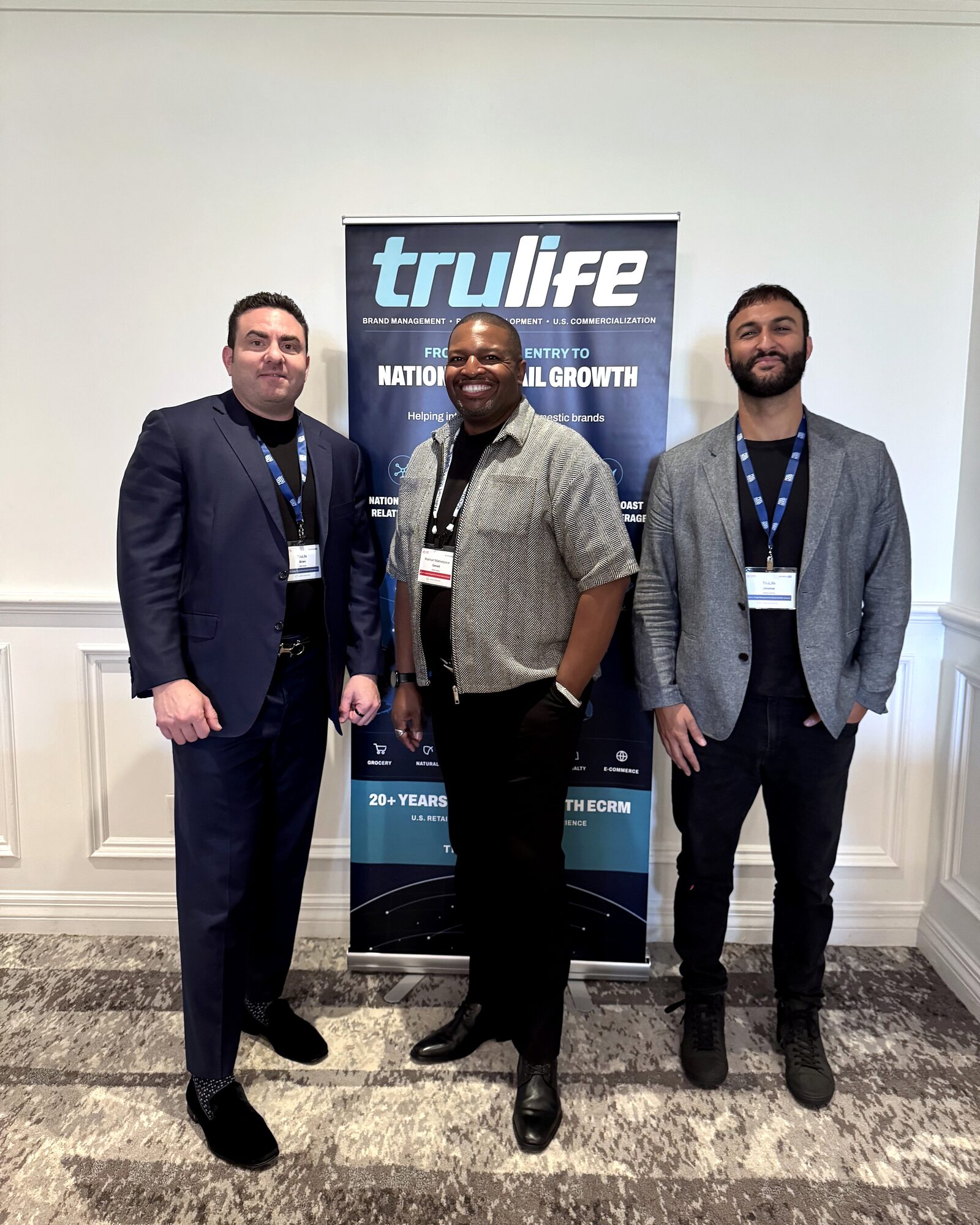
Buyer access is only the beginning. TruLife manages the preparation, commercial requirements and follow-through needed to move a retail conversation toward an actual business opportunity.
See How TruLife Develops U.S. Retail Accounts →Retailer names and photographs are shown to document TruLife Distribution’s buyer conversations. Meetings do not imply retailer endorsement, purchase commitment or guaranteed placement.
Is Your Brand Ready to Meet U.S. Retail?
TruLife helps emerging and international brands prepare for, access and execute opportunities across the U.S. retail market.
The model
One commercial function, one set of incentives.
Compliance informs the label, the label informs the pitch, the pitch informs the forecast, and the forecast informs the inventory. That chain only holds when one team is responsible for all of it.
It is the same reason we don't work commission-only and don't guarantee outcomes. Both arrangements sound like they favour the brand, and both quietly move the risk to the party with the least ability to manage it.
Go deeper
Read the detail before you commit to anything.
How we work
The four phases, what we commit to, and how the relationship is structured.
See the process →Client case studies
Documented launches, by origin market and channel.
Read the case studies →Retail Readiness Assessment
Complete the assessment, then enter your contact details to view and receive your score, readiness band and three biggest gaps.
Start the assessment →Questions
Frequently asked.
- Are you a distributor?
- No, despite the name. A distributor buys product and resells it, and its margin comes from that transaction. We don't take title to your inventory. We run the commercial function — compliance, pricing, buyer representation, marketplace and marketing — on your behalf, and we manage distributors as part of that.
- Do we still need a distributor if we work with you?
- Usually yes, for the logistics route into certain chains. The difference is that the wholesaler relationship becomes one component we manage rather than the whole of your U.S. strategy.
- Could we just hire a broker?
- If your only gap is buyer access in a single channel, and the product is already compliant, priced and in stock, a broker can be the efficient answer. Brokers struggle when the brand isn't ready, because they are paid on what sells and an unready brand doesn't.
- Why not a consultant plus our own team?
- That works when you have a U.S. team to execute the recommendations. Most international brands entering this market don't, which is how a good strategy document ends up in a drawer.
- Isn't one partner for everything a concentration risk?
- It concentrates accountability, which is the point. The alternative — five vendors, five contracts and five partial views — distributes the risk so widely that when a purchase order is missed, every one of them is technically right.
- When are you not the right answer?
- When you already have a U.S. commercial team and only need a specialist gap filled. When the product isn't differentiated enough to earn shelf space. When the margin structure can't carry the U.S. chain. We say so at the assessment stage.
U.S. Market Assessment — $3,500
Find out what America would actually take.
Send us your product and your numbers. We'll come back with a written assessment of what entering U.S. retail would require and what it would realistically return.